
If you do one thing while visiting New Orleans, I would definitely recommend this. The small group is worth it. We were six people in our airboat, plus our guide, and spent two hours out in the bayous of Louisiana.
The bayou is really interesting. On the one hand, there is brackish water and tall reeds, with water plants thrown in for good measure. It's easy to spot the old hunting lodges - they are typically on stilts and visible above the reeds. Travelling at high speeds in some places, I felt like I was in the opening scenes of CSI Miami, except this wasn't the everglades.
And then there are the cyprus swamps. Some are old logging canals, when cyprus trees were being logged. Those ones tended to be long and straight. Others were naturally formed, and twisted and turned as we travelled in the boat. Lush cyprus trees, with over hanging branches covered in spanish moss, turtles sunning themselves on patches of land or driftwood, algae floating delicately on the water in places, birds calling in the distsnce. Paints a beautiful picture, doesn't it? And it is definitely beautiful, and dangerous. There are snakes and alligators. Okay, we didn't see any snakes, but our guide, Steve, told us they are often in the tree branches overhanging the water. Just as well that we didn't see any, because I don't like snakes. But there ARE alligators, lots of alligators, and we did see them. Sometimes they were in the water in the distance. Often, they looked like logs covered in algae, until we got up close and realized that the 'log' had eyes and only the head was visible above the water. Sometimes, they were curious and came up close to the boat.
Bayou crack- ever heard of it? We know it as marshmallows. Throw a white marshmallow in the bayou and watch what happens. Alligators eat them. Seems they are attracted to things that are white. For me with my white hair, that means don't lean over the edge of the boat. Where one eats, others come to investigate, and soon we had three or four at the side of the boat. When Steve took out hot dogs, things got even more interesting. He put a piece of hot dog on the end of a stick about four feet long, and held it out over the water, and lo and behold, the alligators jumped in the air for it. One even got his head on the edge if the boat. Steve told us that alligators can jump about half their body length, so feeding them by hand is a big no no. Put the food on the end of a stick, and stand well back!
On the way back to the dock, Steve stopped the boat, and had a surprise for us in his cooler- a baby alligator. Only about 11 months old, and a foot long, its teeth were like needles and could inflict some painful damage if we were not careful. He showed us how to hold the baby gator. We all took turns, what a treat that was. A great way to end our excursion.
As a bonus, on the way back to the dock, we saw a bald eagle. Got a few good pictures of it, too.
Saturday, September 28, 2013

Thursday, September 26, 2013
Oak Alley Plantation
Ealier this week, we visited Oak Alley plantation. If you've ever seen Interview with the Vampire, or Hush, Hush, Sweet Charlotte, you'll recognize the place. If you only visit one of the plantations on the river road, bordering the mighty Mississippi, I would recommend this one. It's definitely like taking a walk back in time.
The plantation dates back to the early 1700s, when an unknown settler planted the row of live oak trees, from which it derives its name. In the 1830s, it was bought by a Creole sugar cane planter, Jacques Roman. Apparently, his young wife was not thrilled with the place, which was then called Beau Sejour, and wanted to spend her time in New Orleans. She considered the plantation out in the boonies.
The plantation house has been restored to its 1830s and 1840s splendour, and you get a good idea of what life would have been like for a Creole planter. The dining room has a table that would easily seat 20. Creoles, to show their wealth, had their silverware in place settings so that the back of the cutlery showed. That way they could display their wealth, because the silver hallmarks on cutlery were always on the backs of the knives, forks, and spoons.
Another interesting custom from the Creoles - only married men, their wives, women and children could live in the big house, or plantation house. Boys, once they reached the age of 15, moved out of the house into a garconiere, where they lived until they got married. Unfortunately, the original garconiere at Oak Alley was demolished in the early 20th century.
The plantation is still a working sugar cane plantation today, and on the grounds, you can still the big sugar kettles. Some are used as planters, or very large flower pots. It's good to see that they are still in use, even if it's not for ithe original purpose.
The best part about the whole tour for me was the alley of live oaks. From the second storey gallery, the view is incredible. A quarter mile of live oaks on either side of a walkway, leading down to the levee at the Mississippi River. In antebellum Louisianna, travel would have been by river. Looking out over the view, I can just imagine a boat pulling up to the plantation dock, disgorging its passengers, who would be met by slaves to take them in a carriage to the big house, where refreshments would await.
Creole ladies were not supposed to drink spirits in front of gentlemen. If they did so, they were not considered ladies. So ladies oftem refreshed themselves with fresh fruit, while the men enjoyed their wine or spirits. Now here's the interesting bit. That fresh fruit..... it was typically soaked in rum
The plantation dates back to the early 1700s, when an unknown settler planted the row of live oak trees, from which it derives its name. In the 1830s, it was bought by a Creole sugar cane planter, Jacques Roman. Apparently, his young wife was not thrilled with the place, which was then called Beau Sejour, and wanted to spend her time in New Orleans. She considered the plantation out in the boonies.
The plantation house has been restored to its 1830s and 1840s splendour, and you get a good idea of what life would have been like for a Creole planter. The dining room has a table that would easily seat 20. Creoles, to show their wealth, had their silverware in place settings so that the back of the cutlery showed. That way they could display their wealth, because the silver hallmarks on cutlery were always on the backs of the knives, forks, and spoons.
Another interesting custom from the Creoles - only married men, their wives, women and children could live in the big house, or plantation house. Boys, once they reached the age of 15, moved out of the house into a garconiere, where they lived until they got married. Unfortunately, the original garconiere at Oak Alley was demolished in the early 20th century.
The plantation is still a working sugar cane plantation today, and on the grounds, you can still the big sugar kettles. Some are used as planters, or very large flower pots. It's good to see that they are still in use, even if it's not for ithe original purpose.
The best part about the whole tour for me was the alley of live oaks. From the second storey gallery, the view is incredible. A quarter mile of live oaks on either side of a walkway, leading down to the levee at the Mississippi River. In antebellum Louisianna, travel would have been by river. Looking out over the view, I can just imagine a boat pulling up to the plantation dock, disgorging its passengers, who would be met by slaves to take them in a carriage to the big house, where refreshments would await.
Creole ladies were not supposed to drink spirits in front of gentlemen. If they did so, they were not considered ladies. So ladies oftem refreshed themselves with fresh fruit, while the men enjoyed their wine or spirits. Now here's the interesting bit. That fresh fruit..... it was typically soaked in rum
Wednesday, September 25, 2013
New Orleans
My sister, Alicia, and I are visiting New Orleans for a week. This is without a doubt one of the friendliest places I have ever been.
The fleur de lys is prominent everwhere here. It was quite a surprise to see it displayed so prominently. But, the fleur de lys has a different meaning than it does back home, where it is the symbol of Quebec, and is largely associated with separatism. Here it symbolises the revitalization of New Orleans after Hurricane Katrina.
The French Quarter, where we are staying, is the oldest part of the city, on the bank of the Mississippi River. It is the original city, and was burned down twice. After the second fire, the city ordered that all new buildings could not be made of wood, rather had to be stone or brick, and had to have some space between buildings, hence the structures we see today with their inner courtyards. As one person said, that requirement really was the first fire code. The architecture is a mixture of French and Spanish influences. I always thought the second storey balconies with the wrought iron railings were French. However our guide on one of the tours we took explained that they were actually a Spanish design. Now that I think of it, it makes sense.
One thing I learned was the difference between a gallery and a balcony. If the structure had a second storey verandah (my word) with supporting pillars underneath from the sidewalk to the underside of the verandah, that's a gallery. The owner of the building had to pay tax on his or her portion of the sidewalk where the gallery existed. If the second storey verandah did not have supporting pillars underneath, that's a balcony. And for the owner, less taxes.
Food here is delicious, and if I'm not careful, I'll undo all the work I've done trying to shed a few pounds. Luckily, Alicia and I have been sharing meals. Hopefully that, and all the walking we've been doing will keep my waistline in check. Blackened shrimp, jambalaya, southern fried chicken, red beans and rice, key lime pie, banana foster ice cream cake - these are some of the dishes we've enjoyed.
Across the street and a few houses up from our hotel is the Beauregard-Keyes House. The house was actually built in the early 1800s, and its chief claim to fame is that it was once rented by General Beauregard (a Confederate general), and was once owned by the author Frances Parkinson Keyes. It's a fine example of a centre hall style house. I thought I would hear a lot more about Gen. Beauregard, and didn't. Thst doesn't mean that I was disappointed, because I wasn't. There are furnishings from the time when the general would have lived there, some of which belonged to his family. And our guide, Ott, did talk about the general. But what I found more interesting was learning about an author I had read oh so many years ago. Mrs. Keyes at first rented the house, and then bought it on the understanding that she would restore it. She was an avid collector of fans and dolls, and you can see much of her collection on display in the house. When we went in, we were given a copy of one of her books to keep. A great keepsake, and a unique way to spark interest.
Unfortunately, this narrative does not have pictures. They will come later, when I've figured out how to work my tablet. But for now, I'll add more stories as I can.
The fleur de lys is prominent everwhere here. It was quite a surprise to see it displayed so prominently. But, the fleur de lys has a different meaning than it does back home, where it is the symbol of Quebec, and is largely associated with separatism. Here it symbolises the revitalization of New Orleans after Hurricane Katrina.
The French Quarter, where we are staying, is the oldest part of the city, on the bank of the Mississippi River. It is the original city, and was burned down twice. After the second fire, the city ordered that all new buildings could not be made of wood, rather had to be stone or brick, and had to have some space between buildings, hence the structures we see today with their inner courtyards. As one person said, that requirement really was the first fire code. The architecture is a mixture of French and Spanish influences. I always thought the second storey balconies with the wrought iron railings were French. However our guide on one of the tours we took explained that they were actually a Spanish design. Now that I think of it, it makes sense.
One thing I learned was the difference between a gallery and a balcony. If the structure had a second storey verandah (my word) with supporting pillars underneath from the sidewalk to the underside of the verandah, that's a gallery. The owner of the building had to pay tax on his or her portion of the sidewalk where the gallery existed. If the second storey verandah did not have supporting pillars underneath, that's a balcony. And for the owner, less taxes.
Food here is delicious, and if I'm not careful, I'll undo all the work I've done trying to shed a few pounds. Luckily, Alicia and I have been sharing meals. Hopefully that, and all the walking we've been doing will keep my waistline in check. Blackened shrimp, jambalaya, southern fried chicken, red beans and rice, key lime pie, banana foster ice cream cake - these are some of the dishes we've enjoyed.
Across the street and a few houses up from our hotel is the Beauregard-Keyes House. The house was actually built in the early 1800s, and its chief claim to fame is that it was once rented by General Beauregard (a Confederate general), and was once owned by the author Frances Parkinson Keyes. It's a fine example of a centre hall style house. I thought I would hear a lot more about Gen. Beauregard, and didn't. Thst doesn't mean that I was disappointed, because I wasn't. There are furnishings from the time when the general would have lived there, some of which belonged to his family. And our guide, Ott, did talk about the general. But what I found more interesting was learning about an author I had read oh so many years ago. Mrs. Keyes at first rented the house, and then bought it on the understanding that she would restore it. She was an avid collector of fans and dolls, and you can see much of her collection on display in the house. When we went in, we were given a copy of one of her books to keep. A great keepsake, and a unique way to spark interest.
Unfortunately, this narrative does not have pictures. They will come later, when I've figured out how to work my tablet. But for now, I'll add more stories as I can.
Saturday, March 30, 2013
Our last two days in Myrtle Beach
Yesterday was a sunny and somewhat warmer day than it has been in the last few weeks. We went to Barefoot Landing to walk around, and enjoy the good weather. First though, we stopped at a local diner to have southern fried chicken. It was delicious. Crispy seasoned chicken, corn bread, and rice and gravy. Not low cal by any means, and the portions were huge, but as a 'once in a blue moon' treat, it was great. And, after eating all of that, I definitely needed to walk off all the calories!
Barefoot Landing was rather deserted at this time of year, but I did get a few pictures of the local residents.
 The cormorants were sunning themselves in the parking lot. Even though we parked next to them, and could walk right up to take their photo, they weren't interested in moving.
 Some of the other inhabitants of Barefoot Landing.
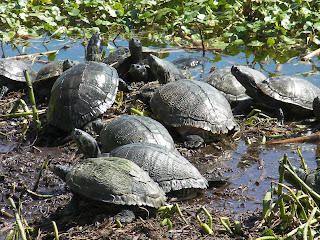 Seems everyone was out enjoying themselves. There were several colonies of turtles on the water's edge, all basking in the sun.
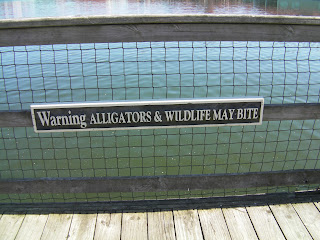 I would have thought it's obvious that alligators might bite. I guess not, because I've seen other signs that read "Do Not Feed the Alligators".

Barefoot Landing was rather deserted at this time of year, but I did get a few pictures of the local residents.
 The cormorants were sunning themselves in the parking lot. Even though we parked next to them, and could walk right up to take their photo, they weren't interested in moving.
 Some of the other inhabitants of Barefoot Landing.
 Seems everyone was out enjoying themselves. There were several colonies of turtles on the water's edge, all basking in the sun.
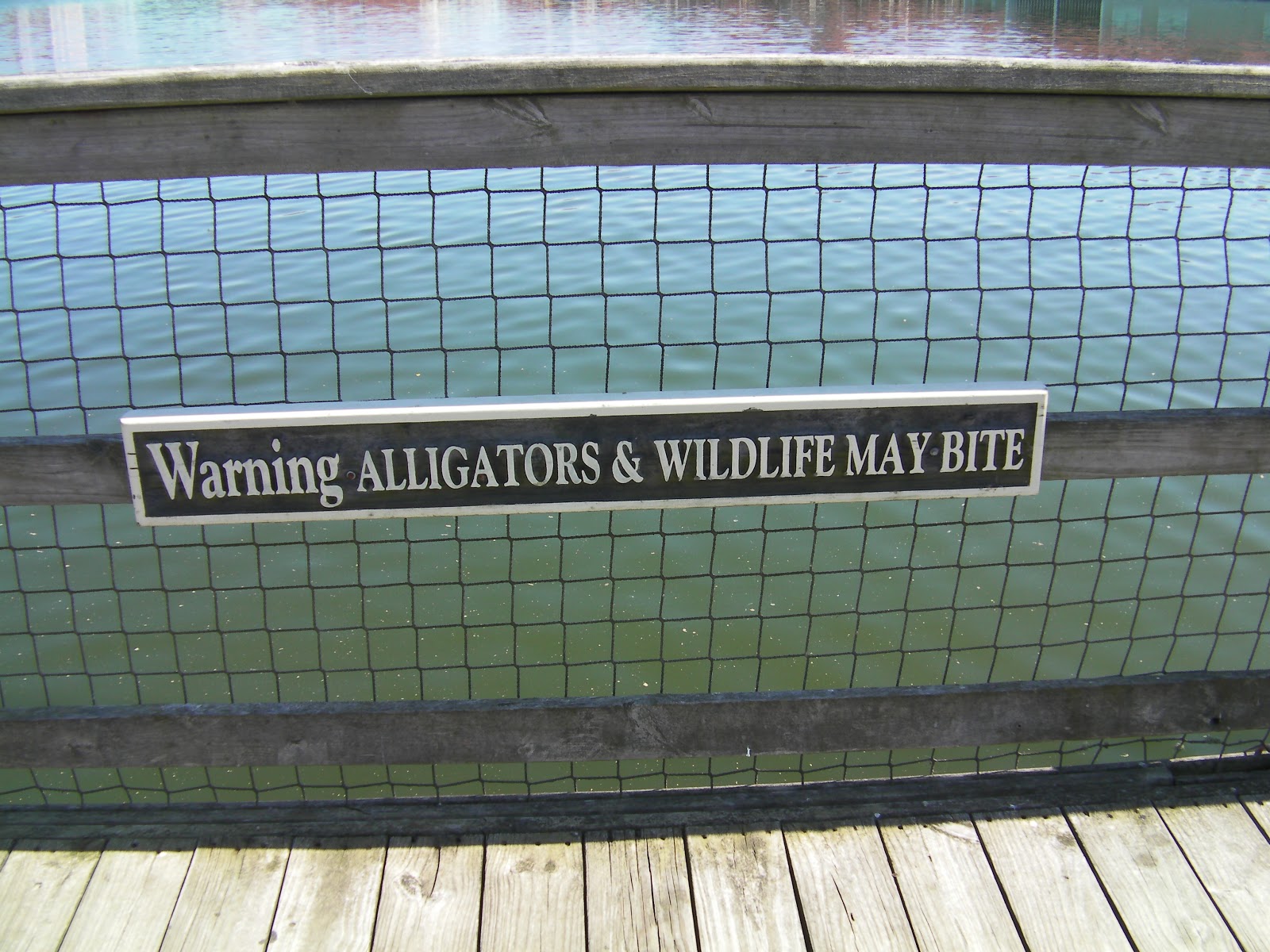 I would have thought it's obvious that alligators might bite. I guess not, because I've seen other signs that read "Do Not Feed the Alligators".
After walking around, Walter treated me to ice cream. Even an ice cream cone here is bigger. The smallest size was a very generous double scoop. I had butter pecan, and Walter had orange sherbet. Both yummy! On top of the fried chicken at lunch, though, it meant that supper was delayed until we were both hungry.
Today it was supposed to rain, but never did. In fact the sun came out, and the temperature climbed to 18C. We played our final game of golf at Tupelo Bay Golf Course. We've played it three times while we were here. I managed to stay out of most of the sand traps, and only had one ball go in the water. Walter, being the chivalrous fellow that he is, retrieved it for me.
While we waiting to tee off on one of the holes, we saw a swan in one of the water hazards. Just happened to have my camera with me.

We finished the day off by having supper at the Bonefish Grill. Tomorrow, we'll be heading for home. We've had a great time, and like all good things, it must come to an end. It will be nice to get back to our own house.
Thursday, March 28, 2013
Birding in Huntington Beach State Park
Today, we went to Huntington Beach State Park. It is very near Brookgreen Gardens, on the other side of the highway. What a treat. We stayed about three hours, walking one of the various trails near the marshes and beach. If you're into birding, and we've just started that, it's a great place to see birds, especially water fowl, in their natural habitat. We saw bald eagles, cranes, herons, egrets, grebes, gulls, terns, ducks, and pelicans. Didn't get pictures of all of them, unfortunately. There are also alligators, but we didn't see any. Below are some of my favourite pictures
 Walter at one of the lookouts over the marsh. On the other side of the marsh are sand dunes and the ocean.
 Cormorant enjoying the sunshine.
 The marsh from one of the lookouts. The steps up to the lookout were steeper than I thought, and I stumbled on them. Didn't get hurt, just got sand all over my jeans. The climb was worth it though. Beyond the trees in the distance is Huntington Beach and the Atlantic Ocean.
 Birds in the marsh. Not sure what they are. I'll have to look them up in Birds of North America when I get home.
 One of the ever present gulls.
 I don't remember what Walter said, but whatever it was, it made me laugh.
 Another part of the marsh, with the sand dunes and ocean in the background. Walter got a great shot.
 Duck nest in the marsh. Right beside it was......
 an egret. Beautiful bird!
.
an egret. Beautiful bird!
.
 Walter at one of the lookouts over the marsh. On the other side of the marsh are sand dunes and the ocean.
 Cormorant enjoying the sunshine.
 The marsh from one of the lookouts. The steps up to the lookout were steeper than I thought, and I stumbled on them. Didn't get hurt, just got sand all over my jeans. The climb was worth it though. Beyond the trees in the distance is Huntington Beach and the Atlantic Ocean.
 Birds in the marsh. Not sure what they are. I'll have to look them up in Birds of North America when I get home.
 One of the ever present gulls.
 I don't remember what Walter said, but whatever it was, it made me laugh.
  Another part of the marsh, with the sand dunes and ocean in the background. Walter got a great shot.
 Duck nest in the marsh. Right beside it was......
 an egret. Beautiful bird!
There are other parts of the park that we didn't get a chance to explore. The beach is huge, and wide. It was a bit cool when we walked around (we're wearing jackets) near the ocean. Definitely a place worth visiting.
Wednesday, March 27, 2013
Conway and Georgetown
Yesterday, we decided to explore a bit of South Carolina and headed to Conway and Georgetown. To me, both these towns epitomized what I thought the small southern town would be. There is a certain charm in them that is hard to describe in words.
Conway, on the Waccamaw River, is a beautiful little town. It was founded in the 1730s, and was originally called Kingston. The river area is quite beautiful, although as it was breezy yesterday, also a bit cool. Still, it is worth a walk around the historic area.
 Conway, it seems, is also a mail depot for Santa Claus. I didn't have time to write him a letter, but I though of Adrien, Lennox and Sydney (my grandchildren) when I saw this.
 This is the Presbyterian Church. Although this building dates from the latter part of the 1800s, there has been a church on this site since the late 1700s. The cemetary, on the side, had some confederate graves, and I took a picture or two.
 One of the Confederate graves. It was nice to see that the grave was cleaned up and honoured. I've seen a few other Confederate graves in my travels, and some of them were quite neglected. No matter what you might think of the Civil War, it's nice to see that folks still honour their dead.
 Looking up the street from the river. Imagine what this would have been like in horse and buggy days. The houses on the left are from the 1800s. It would have been quite an imposing site, riding up the church, which is at the top of a very gentle hill.
 This is the Morgan House. Mr. Morgan was the mayor in the early 1900s, and was instrumental in bringing water and sewer systems, electric lights, paved roads and sidewalks to the city, among other things. The side streets have several houses like this. Beautiful!
 The most interesting residents of Georgetown that we met were these three. I first I thought they were decoys, but they are the real thing. The ducks were comfortably enjoying a bit of sunshine on the sidewalk, and would not move for any pedestrians, thereby forcing us to walk around them, while being scolded by one of the drakes for being too close to his mate.
 Isn't he a handsome fellow? He seemed to enjoy posing for pictures, turning his head to get the best profile.

Conway, on the Waccamaw River, is a beautiful little town. It was founded in the 1730s, and was originally called Kingston. The river area is quite beautiful, although as it was breezy yesterday, also a bit cool. Still, it is worth a walk around the historic area.
 Conway, it seems, is also a mail depot for Santa Claus. I didn't have time to write him a letter, but I though of Adrien, Lennox and Sydney (my grandchildren) when I saw this.
 This is the Presbyterian Church. Although this building dates from the latter part of the 1800s, there has been a church on this site since the late 1700s. The cemetary, on the side, had some confederate graves, and I took a picture or two.
 One of the Confederate graves. It was nice to see that the grave was cleaned up and honoured. I've seen a few other Confederate graves in my travels, and some of them were quite neglected. No matter what you might think of the Civil War, it's nice to see that folks still honour their dead.
 Looking up the street from the river. Imagine what this would have been like in horse and buggy days. The houses on the left are from the 1800s. It would have been quite an imposing site, riding up the church, which is at the top of a very gentle hill.
Georgetown is the third oldest city in South Carolina. It's an Winyah Bay, where three rivers, including the Waccamaw, meet. It's been known for shipping rice (in fact, it has a rice museum), and logging. The residential streets have beautiful live oaks, that reach over the street, creating a canopy of green, and some georgeous houses.
 This is the Morgan House. Mr. Morgan was the mayor in the early 1900s, and was instrumental in bringing water and sewer systems, electric lights, paved roads and sidewalks to the city, among other things. The side streets have several houses like this. Beautiful!
 The most interesting residents of Georgetown that we met were these three. I first I thought they were decoys, but they are the real thing. The ducks were comfortably enjoying a bit of sunshine on the sidewalk, and would not move for any pedestrians, thereby forcing us to walk around them, while being scolded by one of the drakes for being too close to his mate.
 Isn't he a handsome fellow? He seemed to enjoy posing for pictures, turning his head to get the best profile.
One of the stores we went into in Georgetown had Tilley Hats. The store had been carrying them for about a year, and the saleslady told us they were selling quite well. I thought that was amusing - seeing a Canadian product in an American store, especially since the Tilley flagship store in Toronto is only a 30 minute drive from home.
Heading home, we decided to stop in at one of our favourite restaurants, the Bonefish Grill, for a bit to eat. Some of our favourite dishes, Bang Bang Shrimp and Tuna Sushi. Delicious, and a nice ending to a good day.

Monday, March 25, 2013
USS North Carolina
Today, we went to Wilmington, in North Carolina, about 56 miles from Myrtle Beach, to see the Battleship USS North Carolina. It was well worth the visit. The North Carolina was active for only seven years. In that time, it had nine captains, all of whom made the rank of Admiral. All of them but one were promoted on leaving the North Carolina. One wasn't but was made admiral later. The North Carolina has been in Wilmington for over 50 years, and is still owned by the United States Navy.
Going aboard the ship is like going back in time. You get a really good sense of what it would have been like, with a full crew of 2300. We climbed from the bridge to the engine room and back again. Walter was really interested in the engine room, but I found it hard to take. Even after all this time, and with air conditioning aboard some areas of the ship, the engine room still smelled of oil or fuel (I'm not sure which), and I started to get a bad headache after only a few minutes there. Still, I'm glad I did it.
What really, for me, set this ship apart as a museum, were the crew's memories. These are posted in various places throughout the ship, and certainly brought a personal point of view to life aboard the ship. The crew were not allowed to keep diaries ( I suppose it was a security breach if they fell into the wrong hands), but they did, and developed some ingenious ways of hiding them. Another interesting little bit that we learned, the Master at Arms (the ship's police force) stored the beer for the crew in the brig. It was a great way of keeping discipline among the crew, because if anyone did anything to require spending time in the brig, the Master at Arms had to throw the beer overboard to make room in the brig for the miscreant. And since no one wanted to lose his beer, it was quite the incentive for everyone to behave!
Afterwards, we had lunch at the Front Street Brewery, a great little bar restaurant. Of course, Walter had a beer, which he enjoyed.
 Walter on the bridge. Full steam ahead!
 One of the ovens for making muffins. Each oven in the stack of six could make 30 muffins at a time.
 One of the officer's quarters. I forget which function the occupant was responsible for, but whatever it was, he didn't leave this room much. His bunk was above his desk.
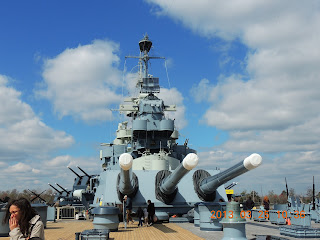 The ship's big guns had a range of 23 miles.
 On the deck - cold and windy. I can't imagine what it would have been like on the open ocean. Those decks behind me are teak, and had to be swabbed on a regular basis. That and painting (the job that never ends) kept the crew busy when they weren't engaged in any other activities.
 Relaxing on shore with a glass of beer.
Going aboard the ship is like going back in time. You get a really good sense of what it would have been like, with a full crew of 2300. We climbed from the bridge to the engine room and back again. Walter was really interested in the engine room, but I found it hard to take. Even after all this time, and with air conditioning aboard some areas of the ship, the engine room still smelled of oil or fuel (I'm not sure which), and I started to get a bad headache after only a few minutes there. Still, I'm glad I did it.
What really, for me, set this ship apart as a museum, were the crew's memories. These are posted in various places throughout the ship, and certainly brought a personal point of view to life aboard the ship. The crew were not allowed to keep diaries ( I suppose it was a security breach if they fell into the wrong hands), but they did, and developed some ingenious ways of hiding them. Another interesting little bit that we learned, the Master at Arms (the ship's police force) stored the beer for the crew in the brig. It was a great way of keeping discipline among the crew, because if anyone did anything to require spending time in the brig, the Master at Arms had to throw the beer overboard to make room in the brig for the miscreant. And since no one wanted to lose his beer, it was quite the incentive for everyone to behave!
Afterwards, we had lunch at the Front Street Brewery, a great little bar restaurant. Of course, Walter had a beer, which he enjoyed.
 Walter on the bridge. Full steam ahead!
 One of the ovens for making muffins. Each oven in the stack of six could make 30 muffins at a time.
  One of the officer's quarters. I forget which function the occupant was responsible for, but whatever it was, he didn't leave this room much. His bunk was above his desk.
  The ship's big guns had a range of 23 miles.
  On the deck - cold and windy. I can't imagine what it would have been like on the open ocean. Those decks behind me are teak, and had to be swabbed on a regular basis. That and painting (the job that never ends) kept the crew busy when they weren't engaged in any other activities.
 Relaxing on shore with a glass of beer.
Subscribe to:
Posts (Atom)